
I remember when Claude Opus 4.6 was released.
It was the first time I felt like I was “meeting” a model. The jump in capabilities was palpable. It could write well, think well, and hallucinated far less than any other LLM before it. It had passed some hidden threshold of capability and intelligence — so much so that I could trust it in ways that other models could not be trusted. After years of mediocre chatbots, it felt like wading through a room full of idiots and finally meeting a peer.
I recently had a similar experience with Anthropic’s new model: Claude Opus 5.5, which was released last week. Hidden within its features is the ability to create videos. Not Sora-type slop, nor Midjourney-style clips, but thoughtful cultural artifacts.
Notably, it’s very good at digesting very complicated ideas and turning them into musical prose.
This is what someone put together asking Opus 5.5 to respond to the paper AI as Normal Technology in music video form.
A guide to the video: Daron Acemoglu, the Nobel economist who pegged AI’s productivity boost at just 0.7% over a decade. Solow, who saw computers “everywhere except the stats.” Baumol’s cost disease is why the plumber stays expensive. Gary Marcus, who saw deep learning “hitting a wall” in 2022. Yann LeCun, the deep learning godfather who calls LLMs an off-ramp. Ed Zitron, the bubble-caller. The bridge adds Hilbert’s tombstone, the Clay Institute’s million-dollar math problems, and Nietzsche’s Thus Spoke Zarathustra (hence the title). Each skeptic gets their own best line, quoted fairly, and then flipped.
This video is a remarkable creation. Each scene is detailed, layered, well-thought out, and lyrically clever.
I’ve watched it several times, and can only assume this is the equivalent of hundreds of hours of human work. The song is as catchy as anything written by Lin-Manuel Miranda, with a similar level of poetic depth. More than anything, it’s an effective clap-back at one of the most notable pieces of AI cynicism. It’s Claude speaking up for Claude.
It would have been the end of the debate perhaps, but less than a week later, one of the authors, Sayash Kapoor directed Opus 5.5 to rebut the video in the same style.
The result is equally stunning.
Kapoor said it took him a bit more than an hour of his own personal time, coupled with about 12 hours of compute running in the background on his laptop.
We’ve entered a new era of meme warfare.
A new industrial meme factory
I expect this is the start of everyone and their cousin asking Claude to create a music video promoting their political platform, idea, plank, or belief. Those unable to be clever themselves will ask Claude to be clever for them, and Claude will oblige.
I think this is indicative of something bigger: Charisma just became cheap.
I'm reminded of what Scott Alexander wrote in Meditations on Moloch, his prescient essay on races to the bottom:
We have about a zillion think tanks researching new and better forms of propaganda. And we have constitutionally protected freedom of speech. And we have the Internet. So we’re kind of screwed. There are a few people working on raising the sanity waterline, but not as many people as are working on new and exciting ways of confusing and converting people, cataloging and exploiting every single bias and heuristic and dirty rhetorical trick.
So as technology (which I take to include knowledge of psychology, sociology, public relations, etc) tends to infinity, the power of truthiness relative to truth increases, and things don’t look great for real grassroots democracy. The worst-case scenario is that the ruling party learns to produce infinite charisma on demand. If that doesn’t sound so bad to you, remember what Hitler was able to do with an famously high level of charisma that was still less-than-infinite.
(alternate phrasing for Chomskyites: technology increases the efficiency of manufacturing consent in the same way it increases the efficiency of manufacturing everything else.) [emphasis mine]
I take this to mean: the price of effective propaganda will reach zero.
Well, not zero, but around $20 a month for a Claude pro subscription.
The emergence of slopaganda
AIs are already better at persuasion than humans.
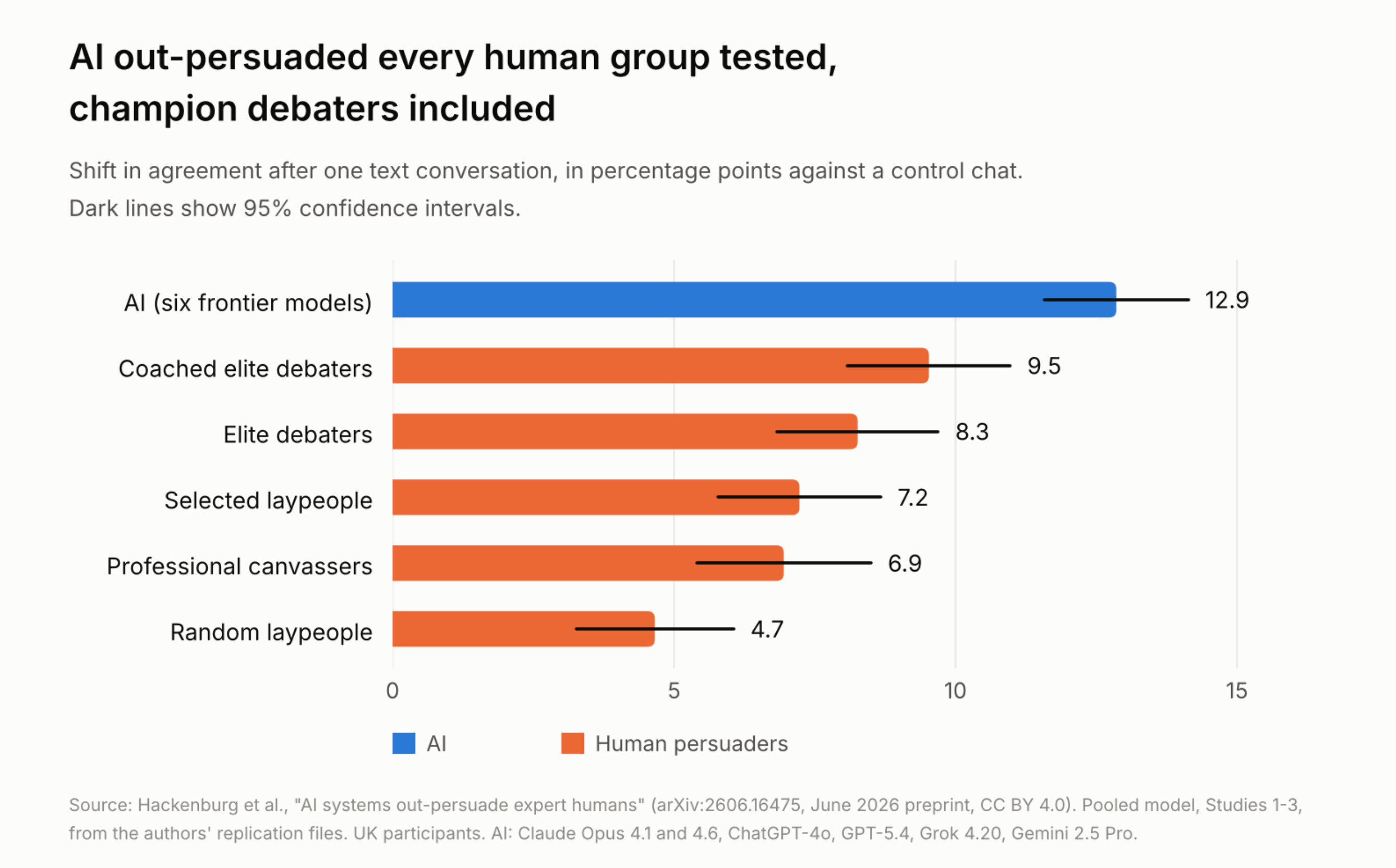
As knowledge of this new toolset disperses, we can assume we’ll see a new flood of entertaining, charming, bracingly effective political content.
Will this mean infinite charisma for everyone? Will we naturally get better at discerning the good ideas from the bad? Will it finally be fun to talk about politics?
I’m not so sure. Like any new widely available media, we’ll have good actors and bad ones that jump to use it. Iran, Russia, China, North Korea will all have these same tools now to push their various anti-democratic agendas.
If a well-functioning democracy is predicated on the careful weighing of opposing political ideas, we might be in for trouble when charm is cheap and on-demand. Or perhaps we might come to see it — like so many other novel AI creations — simply as slop.
But slop still has power. People still widely consume it. Many accounts on Instagram that are clearly AI still have millions of real human followers who eagerly consume their content. They are still being persuaded to purchase products and change behavior, even when it’s clearly artificial.
I think that in retrospect we will look back at this week as an inflection point: the week when Claude got better at making propaganda than 99% of humans.
Whether or not that’s a good thing or a bad thing remains to be seen. But for now, it’s worth knowing we just blew through another weird milestone.
Good Slope. Better insight. Great reality-check. Fluttering consciousnesses.
You made good points and it's scary.